
Novelist
T. A. Keenan
Author of Tom Ryan's Shoes: Legend of the Banshee Castle

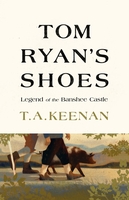
Ireland, 1846. The Great Famine grips the land—and the road north may be the only road left.In famine-stricken 19th-century Ireland, young Tom Ryan leaves Ballyhooly with his cousin Frank and a pig named Toto, setting out across the rugged Galtee Mountains toward the promise of opportunity in Tipperary. What begins as a practical journey soon becomes a passage through a country unraveling under the weight of hunger, eviction, violence, and despair.The Irish countryside has turned perilous. Starving families line the roads. Ruthless land agents enforce brutal order. Soup kitchens trade food for faith. Secret societies lurk in the shadows. And always nearby is the enigmatic bean feasa—an old seer known only as The Hag—a figure steeped in Celtic folklore and Irish mythology, who dispenses cryptic wisdom, demands small services, and intervenes in destinies with unsettling precision.As famine, faith, and fate collide, Tom must decide what kind of man he will become in a world where survival often comes at a moral cost. With each mile, he confronts questions of loyalty, identity, land, love, and the fragile line between the natural and the supernatural.Tom Ryan’s Shoes: The Legend of the Banshee Castle
is sweeping Irish historical fiction infused with Celtic legend, magical realism, and mythic storytelling. Rich in atmosphere and grounded in the history of the Great Irish Famine, this epic coming-of-age adventure blends folklore, literary depth, dark humor, and historical drama into a powerful tale of resilience and transformation.A haunting and immersive journey through 19th-century Ireland, where history and legend walk side by side—and where even in humanity’s darkest hours, myth and mercy endure.
Theme 1:
Systemic Indifference vs. Moral Imperative of Charity
Tom Ryan' Shoes interrogates how political ideology and economic frameworks transform human suffering into acceptable collateral damage. General Bishop's Malthusian coldness and the Gombeen man's exploitation represent institutional evil, while the Hag's coercive charity argues that when systems fail, individuals bear an absolute moral obligation to act, even by force. The novel refuses to let anyone off the hook, implicating the Irish middle class alongside British colonial policy.
Theme 2:
Female Sovereignty as a Foundation of Civilized Society
Ellen's riddle and Lady Edith's dramatic intervention reframe power. The novel suggests that coercive patriarchal structures, whether enforced by Church, Crown, or social convention, are fundamentally destabilizing. True community resilience, the narrative insists, depends on women holding authority over their own fates. Lady Edith bridges pagan folklore and aristocratic power to demonstrate that sovereignty is not granted but reclaimed.
Theme 3:
Storytelling and Folklore as Instruments of Survival
By nesting the famine narrative inside a Depression-era family legend, the author suggests that myths do the work history cannot. Statistics record death tolls; legends teach people how to endure. The magical elements, leprechauns, the bean feasa, the raven, are not escapism but a cultural immune system, processing collective trauma into transmissible wisdom that crosses generations and oceans.
Theme 4:
Identity, Moral Integrity, and the Refusal to Become the Enemy
Tom's shoes are a sustained metaphor for staying grounded in one's own values. The leprechaun's warning against soldier's buttons crystallizes the novel's central moral tension: survival that requires abandoning your principles is no survival at all. Frank's tragic arc, a man who served the Crown and was destroyed by his own countrymen, illustrates how war and empire corrode identity from both directions.
Theme 5:
Internal Division as a Compounding Catastrophe
The Whiteboys who murder Frank expose a painful truth the novel refuses to soften: oppressed communities can become their own worst enemies. Ireland's internal fractures, religious, class-based, and ideological, amplified the Famine's devastation. Keenan treats this not as a condemnation but as a tragedy born of desperation, asking readers to consider how systemic cruelty manufactures the conditions for communal self-destruction.